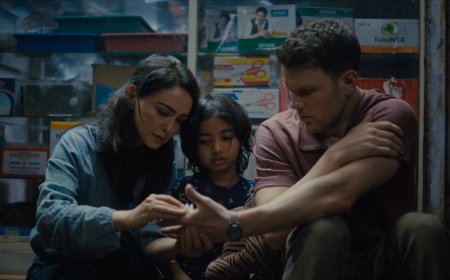
In the Room - Interview
Ricardo Reviews interview with the director of In the Room documentary at SBIFF.

I asked one of my sources who is a therapist the following question:
"I am currently working on a story about the loss of women's rights in Afghanistan and want to know your perspective. Care to share?"
Instead, she came up with the following questions to ask the filmmaker Brishkay Ahmed:
1. Is the spiritual and educational/vocational starvation of women a qualifier for American involvement, the same as physical starvation?
2. Is the abuse of women in Afghanistan, the breaking of their personhood alone at a level that warrants U.S. intervention or even threats of intervention?
3. What message is sent, and what are the consequences within and outside of Afghanistan from the status quo?
4. How did the progress made become spoiled?
5. How much of a gap is there between the surface perceptions of the U.S. "working with Afghanistan" vs. a day in the life of the Afghani people?
The filmmaker was having computer problems as noted by her publicist:
"Brishkay's computer is still down but she made a voice recording of her answers and provided us with a transcript."
I am thankful for the filmmaker responding to my sources questions as follows (also available via audio in her own words):
Brishkay Ahmed (00:03)
So the question is the spiritual and educational evocational starvation of women, a qualified for American involvement, the same as physical starvation. So I will enter the first part because I'm not very sure. I understand the element of physical starvation, but is the spiritual and educational or vocational starvation of women.
Brishkay Ahmed (00:29)
A qualifier for American involvement, I read this question to mean that spiritually, the women Our depleted education, they don't have rights vocational. They cannot work. And so they are starving.
Brishkay Ahmed (00:45)
For Our opportunity to live basically and to thrive in any sense. So does that qualify? American intervention and involvement.
Brishkay Ahmed (01:04)
I would read that, as does that allow America to enter Afghanistan again and come and participate in either the destruction of the country or The rebuilding of the country. America has proven that it can be either or in its geopolitical Our decision-making in action. At this point I would say that Afghan women I need to have access to education.
Brishkay Ahmed (01:39)
They need to be able to work. They need to have access to some kind of income. They need to have the right of mobility to be able to get around and buy simple things like bread.
Brishkay Ahmed (01:51)
Or to go through the doctor because these needs are so dire. Example, the need to go visit a doctor and if a woman doesn't have a male companion, she cannot do that, or she will suffer as she's going to the doctor. So Just understanding that if someone is super ill and they don't have a male companion as a woman, particularly if she's a young woman, she needs to drag herself out to go to the hospital and en route she will be attacked simply because she is alone despite the fact that she's ill.
Brishkay Ahmed (02:30)
Maybe even dying. So knowing that a human being is in that circ in that situation, I would say yes, it does justify intervention even by America even when America has shown us that sometimes many times its intervention has been quite horrific on occasion like in the early days of the rebuilding phase in Afghanistan 2002 345 all the way until 2012 america's intervention was working, it was helping as was NATO's and the rest of the world that was in Afghanistan, helping it rebuild. So I have seen the good as well of America.
Brishkay Ahmed (03:08)
Involvement. I know if the bad as well. In this case, I would say Yes, America should get involved America put us in this situation.
Brishkay Ahmed (03:21)
It was Donald Trump that finally sealed the deal and Joe Biden as well. So I would say, at this point, yes, America's involvement is still justified despite the fact of its horrific history in other parts of the globe. And even inside Afghanistan, at this point, Afghan women can no longer be left in the grip of a fundamentalist totalitarian regime that will punish a woman who is outside alone, trying to make her way with her baby.
Brishkay Ahmed (03:52)
For instance, to a hospital to get something to just be able to have the next breath. So, yes, it does qualify. The next question is the abuse of women in Afghanistan, the breaking of their personhood alone at a level that warrants youth's us intervention, or even threats of intervention.
Brishkay Ahmed (04:17)
I'm reading this question as somewhat similar to the previous one. And if I am mistaken, apologies, Ricardo, English is my second language. But is the abuse of women in Afghanistan, the breaking of their personhood alone?
Brishkay Ahmed (04:33)
At the level that warrants us intervention, or even threats of intervention. I think absolutely, and I really like that. You've used the word the breaking of their personhood.
Brishkay Ahmed (04:45)
And because it's true, it's the breaking of their personhood, their humanhood, basically, and women are in Afghanistan are severely abused. So I would say that absolutely, we need intervention. We need us intervention.
Brishkay Ahmed (05:00)
We need global intervention. Because I personally don't know how much worse it can get for women and girls in Afghanistan. What is worse than what it is already?
Brishkay Ahmed (05:12)
And I understand that there are women in Afghanistan who are, you know? Sustaining somewhat of a comfortable life, but those women usually have strong male figures in their family living with them, or they have Some kind of wealth they own property, they have connections. They have family in the Diaspora that sends them money.
Brishkay Ahmed (05:37)
So they're able to, you know, bribe bad tolebs to sort of you know, give them some break, allow them to go from here to there because they're able to bribe them. But the majority of Afghan women inside Afghanistan do not have wealth. Do not have a Diaspora expat family that sends them money.
Brishkay Ahmed (06:03)
And many of them don't have male relatives living with them or even in their neighborhood, someone they can trust. So for those women who don't have these things, they're already in hell beyond belief. So I would say, yes, we need intervention.
Brishkay Ahmed (06:20)
I call for that I take the risk. Absolutely. And I think that when the Taliban came inside, Afghanistan saw very clearly the terror and the fear that was not just on the faces.
Brishkay Ahmed (06:34)
And demonstrated by the actions of Afghan women, also by the men there was tremendous terror I mean there were people literally A holding onto airplanes that were taking off that risked falling off airplane and dying rather than remaining on that land so that visual display showed you, the Afghan people wanted intervention. Yes, absolutely. And I know that it comes with a risk.
Brishkay Ahmed (07:06)
What message is sent and what are the consequences within and outside of Afghanistan, from the status quo? I guess in this question Ricardo. I'm a little confused about the status quo.
Brishkay Ahmed (07:23)
Do you mean the status quo as in the global community? Are the Afghan population what messages sent? And what are the consequences within and outside of Afghanistan?
Brishkay Ahmed (07:35)
So inside Afghanistan, if there is no intervention If people are just left in the hands of the Taliban, I'm just going to interpret the question that way. What will? What will be the result?
Brishkay Ahmed (07:48)
Well, you're going to get a nation that It's going to produce a suicide bombers and terrorists for the rest of the world. And because basically that's the only thing that the Taliban are good at. They have madrasa schools where young little boys are thought to only study the Quran, and thought to study it in the way that is interpreted by the Taliban sharia law, which basically calls for the murder of all infidels and all infidels are anybody that does not follow their sharia law Islam interpretation.
Brishkay Ahmed (08:30)
So their war is not just with women, and you know, inside Afghanistan, their war is with the globe. So if we want people around the globe to live safer happier, then you want this terrorist regime inside Afghanistan removed because all they are doing is creating hate teaching. People teaching their young boys to hate all the other people that do not follow their sharia law and they're not just teaching them to hate.
Brishkay Ahmed (09:01)
They're teaching them to kill so it's based Afghanistan in their hands in the hands of a Taliban is basically a factory, an assembly line factory, creating terrorists to go out. And Add terror to the rest of the globe. That's one thing.
Brishkay Ahmed (09:23)
So that does not benefit the globe. Number two, you have a country that could potentially be of service to the rest of the world through its people. And through its resources, Afghanistan has a tremendous amount of resources that they can use to rebuild, but also give back to the global community.
Brishkay Ahmed (09:44)
And so there's a lot of loss. That is happening if Afghanistan is left as it is. Next question, how did the pro?
Brishkay Ahmed (09:56)
How did the progress made become spoiled? This is a very good question. How did the progress made become spoiled?
Brishkay Ahmed (10:03)
Well? Ricardo, there was a tremendous amount of progress. You're right, billions and billions, and billions of dollars was spent hundreds of thousands of people from the globe as NATO, American military Afghan police force.
Brishkay Ahmed (10:17)
Afghan military were inside Afghanistan for you know, 20 years, rebuilding it. So many soldiers died from across the globe. American soldiers died.
Brishkay Ahmed (10:27)
Canadian soldiers died. Afghan soldiers died. Spent a tremendous amount of effort and loss and energy and love and pain in the rebuilding of Afghanistan.
Brishkay Ahmed (10:40)
We went from a country that women more just inside the burcas, not allowed to go outside to a country where women were on television, presenting the news with just a headscarf, sometimes without a headscarf, where young girls had, you know, or inside every hospital every clinic. Every school were running businesses. Were, you know, studying robotic sciences, robotic engineering, there was so much progress made, and how did we lose it all?
Brishkay Ahmed (11:16)
We lost it because Afghan people were not given a voice number one through the entire Doha. Taliban talk, the Afghan president and our Afghan government was not given a seat on the table. Women were not given a seat on the table.
Brishkay Ahmed (11:33)
Sure, you see some imagery of a few women, 4 or 5 that supposedly were supposed to represent the rest of the women, but that was not the case. Those women were specifically chosen because they decided to represent Afghan women sort of as a mock version, a symbolic in a sense. I will say that they were more symbolic sort of statues on the table.
Brishkay Ahmed (12:02)
They didn't really have a voice, and they know that they've told me that so the entire world with leading the United States. The United States was the lead in it. It decided to shape the faith of the entire Afghan nation without participation by the Afghan government, the Afghan president, the Afghan people and the women.
Brishkay Ahmed (12:30)
And basically the United States in Doha, along with several other Western nations, Germany was present. Several Arab nations were present. It was in Qatar, so they all gathered and decided the faith of a nation without participation from the people of the nation.
Brishkay Ahmed (12:51)
So how did it get spoiled? It got spoiled by decision-making outside of Afghanistan. And the Taliban that came back to Afghanistan, most of them were in Guantanamo, most of them, all of them that at least of the 5 or 6 top leaders that were in Doha, negotiating the talks, negotiating a deal that worked for them were in Guantanamo, recognized as terrorists.
Brishkay Ahmed (13:18)
All of them so a group of terrorists with the global community spoiled, it The same progress that was made by the same people, by the same Western nations. Most of those Western nations decided that the approach to exclude the Afghan people and exclude the government from this conversation was acceptable. So it was not spoiled because of the Afghan people.
Brishkay Ahmed (13:47)
It was spoiled because the Afghan people had no voice or say in it and it was spoiled. Because Afghan women were given 0 time and space to speak about what they think is right. And lastly, let's see I'm looking up here for the final question.
Brishkay Ahmed (14:06)
How much of a gap is there between the perception of the US working with Afghanistan versus a day? In the life of the Afghani, people. How much of a gap is there between the surface perception?
Brishkay Ahmed (14:22)
Well, present, they There is. A tremendous gap. Is the US working with Afghanistan right now?
Brishkay Ahmed (14:35)
No, that is absolutely not right now. Because they've negotiated that deal. And the deal that was negotiated was such that The United States and the international community will not interfere with what the Taliban does as a government.
Brishkay Ahmed (14:52)
Inside Afghanistan, inside Afghanistan, the Taliban have been given a free ride. They can do as they wish in all matters. The deal has also said that outside of Afghanistan and in the borders around Afghanistan and so forth.
Brishkay Ahmed (15:07)
The Taliban cannot do anything without consulting the United States, the other Western Partners and the Gulf nations. So just to clarify that. So You know, present day, the US is working against Afghanistan.
Brishkay Ahmed (15:24)
Because everybody knows the simple fact that the Taliban government does get money from the United States regularly. That is that is known. And the reason they get this money is because they need to keep the region in somewhat under control and not interfere outside.
Brishkay Ahmed (15:42)
The Afghanistan's borders with other nations. So You know, and Priscilla, I would say that they're working against Afghanistan, so in the simple day of the life of the Afghani people you know, there is I there is a complete detachment from the US and the Western nations. And even the Gulf nations right now, there is a fractured bond.
Brishkay Ahmed (16:08)
A very, very fractured bond that That is probably unforgivable in some sense. So I don't know how the regular everyday Afghani person. I'm sort of survives, and I don't know.
Brishkay Ahmed (16:30)
How much of a met Either anger grief, resentment, they might have towards the United States and other Western nations. And the Gulf nations that allowed the horrors that are on them to occur. You know, I do remember back in the day.
Brishkay Ahmed (16:48)
The everyday Afghani people, and I would say that most of the everyday Afghani people, even when I was in Afghanistan a few years ago, are you lower middle class? Quite poor there was there was even then there seemed to be, you know, a perception that the United States was helping them. That perception was there even for the even for that everyday person who had to, you know, beg on the street for their bread, there was sort of an understanding during the rebuilding phase that the Americans are here.
Brishkay Ahmed (17:27)
And they are doing good despite the fact that all they had was bread and the girls, the women and girls knew that, you know, they had the right to go to school. And just having their right to go to school, they knew that America was involved in in allowing that somehow, and they knew that their America was working with them. They understood that through these tiny, tiny little gifts.
Brishkay Ahmed (17:56)
So now I'm pretty sure that the same everyday people are very well aware of the fact that the United States is not working with Afghan people, but at the same time, their hearts are really calling for the United States and the other Western nations. And the Gulf nations to work with them to step in intervene, take action. Just so that they can have their basic human rights.
Brishkay Ahmed (18:24)
Thank you.
What's Your Reaction?
Like
1
Dislike
0
Love
0
Funny
0
Angry
0
Sad
0
Wow
0